And its powerfull effects over our system
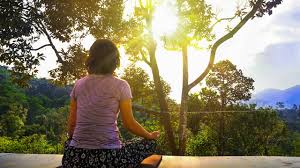
*What comes immediately to your mind when you think about or when someone addresses you to the word meditation? I`m pretty sure that this landscape description would fit: nature, and a monk seat over a high mountain out there in a remote place in Asia, though this might not be wrong, in fact we attribute meditation to oriental cultures and all humanity have been blessed with their legendary wisdom on the field. Actually meditation was first developed in India, a very long time ago. The oldest documented evidence of the practice of meditation are wall arts in the Indian subcontinent from approximately 5,000 to 3,500 BCE, showing people seated in meditative postures with half-closed eyes.(wikypedia source) And although the basics principles of meditation has its roots in India, the exact origins of Buddhist meditation are subject to debate among scholars.
Fortunately meditation has evolved and encounters another practical significance or meaning for each one of us, furthermore in an accessible way. So there`s no longer need to think that in order to get involved with meditation would be necessary to travel to Asia, pick up a trip to find out a wise monk willing to teach you the basic guidelines of it, or even climbing a risk mounting that get you to that peacefully places called monastery’s.

So as I mentioned early there`s no need to go through that motions, relax, and take a deep breathe, since you would be able to learn, whatever you may be to meditate. But, what`s about? Now, you`re in such a better position to understand, but it’s basically rely into learning to handle breath techniques and follow along with our mind.
So there`s for sure a connection between mindfulness practice or meditation and brain stimulation. How does influences our brain functions? Some mindfulness techniques really does have an impact on certain brain areas- so in a few and simple words to make it they concept more clear what mindfulness is inviting you to do is, to make some space within your routine life, not taking it as a lost or a waste of time.
As an analogy I`d ask you to picture in your mind for a minute, what would be of a woodcutter, if he considers that taking a time to sharpen his ax would mean or represent a waste of time. Of course he doesn’t, because that is, what allows him to perform his work the beast or to reach out the best results.
Thus we may see that, as we all may experience in today’s hurry society, that we`re not understanding how beneficial might be to give us a restoring space. Human beings desperately needs a spring moment, and when those spaces are not there our body would begin to suffer it`s consequences, not just for us but for all around us also.
There are several variety of mindfulness practices, the most basics generally consists in trying to handle difficult emotional states by simply breathing deeply and focus your mind while you do it, It may sound simple but it`ll take some time until you get used with this technique. Furthermore you can practice whenever you might be and the more you`ll practice the most likely you`ll be able to better handle stress and even most important, the harmful effect it has in your body-
Researchers known that when a person is on tension is activated a part of our Nervous System called sympathetic system, as if were activating an alarm system, also we all have in temporal area, behind our ears and within our brain, a structure called amygdala, which when is activated will run the sympathetic system, with all that it means to our body responses: raise blood pressure, accelerate heart rate and prepares us for stressful situations, so we`re in alert.
The winner of medicine Nobel in 1949 researcher Walter Rudolf Hess had found also another structure in the anterior area of the hypothalamus which each time that was stimulated caused the contrary effects regarding the sympathetic system. While he was seeking out into the conventional responses to revert those sympathetic negative effects and medicine keep telling him that there was no way to be able to stimulate that nucleus due its deepen and no accessible dimension. As time went by, he came across a book which addresses Buddhist practices which after some research he came up with the conclusion that all they were doing was mostly based on meditation practices, that was the way to stimulate this nucleus to revert the negative effects of sympathetic system-
Tones of Studies has demonstrate that mindfulness techniques has a positive effect over our memory, increasing it and over the way we learn, making the process even enriching, enhancing our capacity to processing information. What are you waiting to start? It would be a good option if we begin to practice mindfulness into our daily basis in order to reduce the negative effects of our society and its demands in life. Give it a try!
 Título del sitio web